The Financial Transaction TaxPart 6 of 6
Who is who in finance
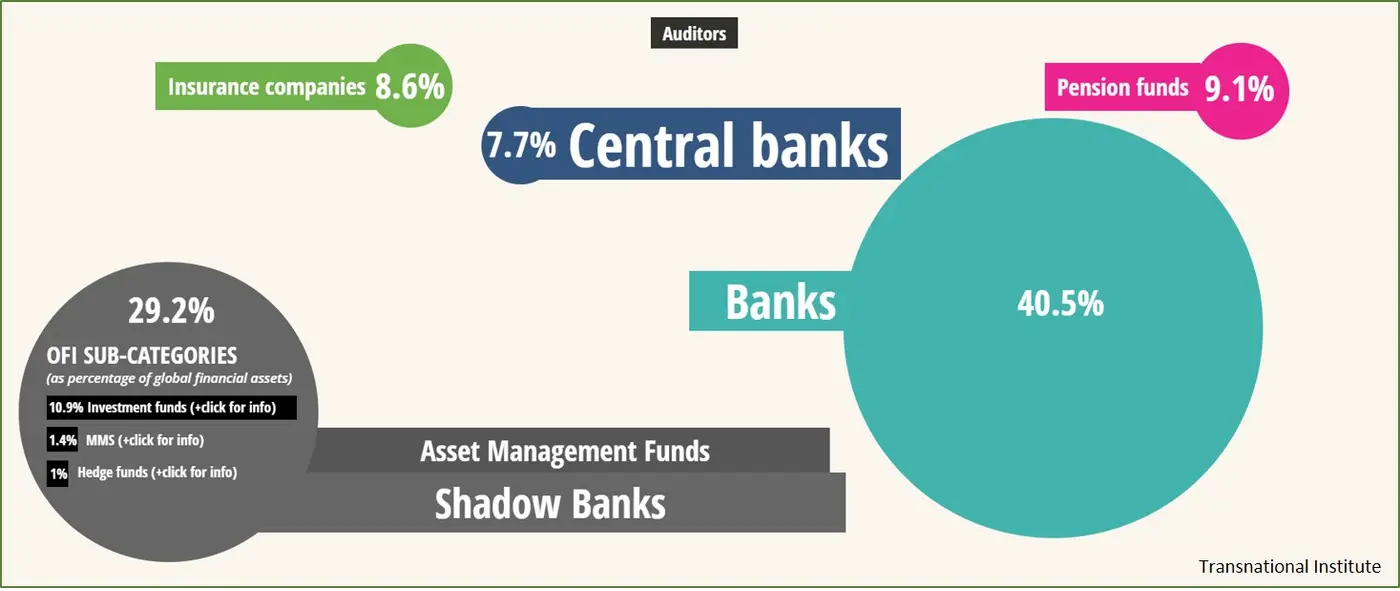
Central banks, banks, funds and auditors. Open each one to see what it does, and how it holds power.

Learn More
How finance controls government
Dozens of powerful financial industry organisations direct government financial policy.
Finance sector spending lobbying outstrips all other industry sectors.
Finance sector dominate funding of political party campaigns.
Public sector finance committees are nearly all finance industry representatives.
Senior government officials move seamlessly between private sectors jobs in the finance sector, and vice versa (revolving door).
When liberal progressive regulation is passing through parliamentary processes, governments allows finance sector to misinform, obfuscate and sue, or threaten to sue them, ensuring potential regulation that threatens profits are derailed.
Financial corporations don’t have to lobby the government. They are the de facto government who in turn ensure the presence of military imperialism to defend capitalism, their wealth and power.
Who is who in finance
National laws/constitution
- Central banks
- Treasuries
- Regulators/member associations
International corporate, legal, financial and tax advisors/auditors
- E.g. Deloitte, Price Waterhouse Coopers, KPMG, Ernst & Young
- E.g. Baker McKenzie, Skadder, Clifford Chance, Linklaters, Freshfields
Insurance companies
- E.g. AXA S.A., Allianze SE, MetLife Inc.
International Investment banks, brokers, and asset and wealth/pension managers
- E.g. Bank of America Merrill Lynch, Goldman Sachs, Morgan Stanley, JP Morgan Chase
- E.g. Credit Suisse, Citigroup, Deutsche Bank, UBS, Barclays
- E.g. Vanguard, BlackRock, Fidelity, The Capital Group, Amundi
- Top 10 asset management firms have over $40,000,000,000,000 ($40 trillion) in wealth, which is half of the annual GDP of every country in the world
International Exchanges and Clearing houses
- E.g. London/New York stock exchanges
- E.g. NASDAQ, Euronext, Chicago Mercantile Exchange
- E.g. London Metals and Bullion markets
Governments, corporates and wealthy people are users of financial markets
Central banks
The central bank sits at the centre of each monetary system, creating the cash, reserves, credit and ultimately taxpayer collateral on which all other banks and other financial institutions depend. The central bank issues the printed notes and coins in circulation, holds foreign reserves to protect currencies against speculation and acts as lender of last resort to the banks if they cannot find money or liquidity in a financial crisis.
Central banks could have many economic goals, such as maximising employment, but in neoliberal times the focus has been on keeping inflation low, principally through changes in the interest rate. Neoliberal approaches also pushed for Central bank independence with the Bank of England granted operational independence in 1997 and the European Central Bank created as independent in 1998.
QE is an unconventional monetary policy aimed to stimulate economic activity. Central banks create new money and use this to buy government and corporate bonds from financial markets. $14tn of Quantitative Easing made by ECB, Bank of England, Bank of Japan and the Fed after the financial crash of 2008 to 2018 to boost corporate profits wealth inequality. This is enough money to hand out $16,279 to every person in Europe, the UK, Japan and the USA.
Role in the 2008 financial crash
- In the wake of the financial crisis, central banks around the world dropped interest rates to almost 0% in order to stimulate the economy.
- When it became clear low interest rates was not going to be enough to kick-start the economy, central banks unconventionally printed vast quantities of new money and pumped it into the banking sector: what is known as Quantitative Easing (QE).
- In total, the top four central banks created more than $14 trillion in new money at a time where most governments cut spending on essential public services arguing that there isn’t enough money.
- QE has failed to increase lending to the real economy and has instead raised asset prices and increased wealth inequality.
- It has not been used for a real transition to a green economy many liberals had hoped for. Interest rates remained at historically unprecedented low rates right up until 2022, by which time the politicians and bankers had caused inflation. Which gave rise to the cost of living crisis, the energy crisis.
- During which time, it is estimated that wealth hidden in tax havens around the world has surpassed $40 trillion dollars, ensuring the rich and every single future generation of theirs never needs to work for a living.
Text adapted from The Transnational Institute
Banks
There are two main types of banks: investment banks and commercial banks. Often the same multinational financial corporation will have both an investment banking and commercial banking wing.
Investment banks conduct initial public offerings when a company wants to float on the stock market, in addition to buying, selling and speculating on bonds, stocks, and other financial instruments. Some also run Asset Management Funds as they group together all these funds in one organisation.
The traditional view of commercial banks is that they are financial intermediaries: taking in savings, issuing deposits, and then channel these savings into loans.
- In reality commercial banks are not financial intermediaries. They are money creating machines.
- Each time they give out a loan they are injecting new money into the capitalist system.
- When these loans are paid back, this money is destroyed.
- In fact, almost all of the money that circulates in the system is not cash: the notes and coins in our wallets.
- 97% of money are bank deposits, which have been created by banks when they give out loans.
The world’s largest banks have given themselves the label, repeated by capitalist policy makers, economists and politicians of being “too big to fail”, or go bankrupt.
- This propaganda enables banks to act with implicit impunity or be given subsidies for their riskier and often fraudulent behaviour, reflected in how they are treated when they break the law.
- Throughout the 2000s, for example, Deutsche Bank lent money to mortgage borrowers it knew could not repay.
- It then sold these junk bonds on to other investors pretending they were decent investments. This type of activity helped to crash the US housing market in 2008 and subsequently the global economy.
- If a person or a smaller corporation had done this, they would be imprisoned and put out of business.
- But with Deutsche Bank, they managed to negotiate their fine down from the original $14 billion amount to $7.2 billion, under the threat that it might bring down the global financial system.
Text adapted from the Transnational Institute
Auditors
Auditors are the pretend private police force of capitalism to give the illusion of stability and science to corporations and governments. They provide the legally required role of assessing the accuracy of the financial statements of the large banks and other financial institutions.
To these same clients, they also provide consultancy and advocacy services, leading many surprised liberals to argue that there is a fundamental conflict of interest at the heart of auditing. The audit industry is dominated by what is known as “The Big Four” - Deloitte, PWC, EY, KPMG.
Together they have 61% share of the EU audit market, and audit between 99 and 100 per cent of the FTSE 100 firms. They also audit 97% of US public companies. As these four firms are the only ones big enough to audit the largest companies and banks, they are effectively protected from failure. In other words, they are an beyond the status of too few to fail, they are normal feature of late stage capitalism – an oligopoly .
Deloitte and Bankia role.
- In 2011, Deloitte audited the profits of the Spanish Bank, Bankia, preparing and signing off reported profits of €300 million.
- The following year the bank was nationalised in a bailout program.
- But when the government started looking through Bankia’s accounts after the sale, it realised that Deloitte had massively hyped up the profits of the bank.
- In 2011, Bankia hadn’t made €300 million. It had actually lost €4.3 billion!
- For this fraud, Deloitte walked away with only a minor €12 million fine, while the taxpayer lost €16 billion.
Pension funds
Pension funds invest people’s money to make returns in order to pay for the income of retirees. The liberal defence of global financial power is that without financial markets creating sophisticated financial products generating high returns, people would not have a pension and an income in retirement.
The idea is that the money driving financial markets is not coming from a wealthy elite, but rather, from the savings of ordinary workers in the form of pensions. This is partly true but it hides how pension wealth is very unequally distributed, and under capitalism, can never be equal, as well as hiding how the risk of paying for retirement has shifted from corporations to workers over the last decade.
In the US a third of Americans have no money put aside at all - a similar figure for the UK. And even for those, who have pensions, they are now largely “defined contribution” plans, where income is not guaranteed and instead depends on how well financial markets are doing.
In other words, capital benefits while workers lose out. Still pension funds do highlight how people can and could influence financial markets and ultimately change where money is invested. However, under capitalism, there is no such thing as ethical investing, despite what pension fund industry says, and is why capitalism cannot be reformed to be 'kind' or ethical, and must ultimately be dismantled.
Text adapted from the Transnational Institute
Insurance companies
Insurance companies are “non-bank” financial institutions that sell instruments and policies that give protection from different risks, such as death, medical issues, asset price deflation, or theft.
Reinsurance companies provide another layer of insurance for the insurance companies themselves, protecting them from unexpected massive payouts such as after a crisis or natural disaster.
Role in the 2008 financial crisis Insurance companies were critical actors in the financial crisis of 2008.
- In the run-up to the crisis, they had issued $45 trillion of Credit Default Swaps (CDS) to banks, a form of insurance to cover them if a loan turns bad and can’t be repaid.
- That is more than the money invested in the U.S. stock market, mortgages, and U.S. Treasury combined.
- Inevitably, when the crisis came, and defaults rose, the insurance companies could not pay out and risked going bust.
- In the case of the US, in 2008 the Federal reserve had to pay out $182.3 billion to save insurance company AIG.
- The US government and most governments around the instituted austerity policies and reducing welfare protections for societies most vulnerable.
- Hundreds of thousands died needlessly from austerity linked policies
Text adapted from the Transnational Institute
Asset management funds
Asset management funds are some of the biggest financial players in the world now as they invest people’s money in many types of funds:
- hedge funds
- investment funds
- Mutual Money Funds (MMFs)
- private equity etc.
Since the financial crisis, asset management funds have grown exponentially, with BlackRock Vanguard (and Fidelity) going from relatively minor players to the biggest financial institutions in the world.
The causes for their success are varied, but one significant factor is their ability to implement low fees due to automated investing strategies, in what is known as passive investing. 199 directors control $41.1 trillion in wealth: 70% are male, and 84% and white European descent.
Blackrock’s rise from the 2008 financial crash:
- BlackRock is the largest financial institution in the world and its success is largely down to the pivotal role it played in the US government bailouts of the financial crisis in 2007/8.
- At a time when the US financial system was collapsing, the Federal Reserve and top Wall Street Executives turned to BlackRock to help assess the value and risks of the balance sheets of failing institutions.
- BlackRock became the manager of the bailout programs, overseeing the $130 billion bailout of Bear Stearns and AIG; the $5 trillion balance sheets of Fannie Mae and Freddie Mac and 1.2 trillion worth of mortgage-backed securities the New York Fed took on to prevent the collapse of the US housing market.
- Part of the answer to why the US government asked Blackrock for help is because it had designed an extremely sophisticated computer system of over 5,000 computers running 24 hours a day, called Aladdin.
- This enabled BlackRock to manage the huge portfolios of the failing banks and insurers.
Text adapted from the Transnational Institute
Investment funds
Investment funds is a general term to describe many different types of funds. Investors, such as wealthy individuals and pension funds, put money into investment funds, which then use this money to buy equity and other financial products.
There are two different types of investment funds:
- Private Equity firms are money managers who take over the actual management of the businesses they buy and change the day to day running of the firm to maximise profits and returns. They are famous for a smash-and-grab style of investing, maximising revenue flows by laying off workers and evading tax. Example: Kohlberg Kravis Roberts (KKR).
- Index funds are called passive as they don’t require actual investors deciding where money should be invested. Instead it is all done by tracking an index, for example the S&P500, the index of the top 500 companies in the US. An index fund will just buy shares of these top 500 companies. When different companies move into and out of the index, the fund will simply sell or buy shares to keep it in line with the S&P500. Index funds have become very popular since the financial crisis, as they have lower fees for investors compared to other active funds because the work is automated. And they tend to perform as well: it is estimated that 50 to 80% of mutual funds fail to beat their benchmark indexes in most years. Example: Vanguard Total World Stock Index Investor Shares.
Concentration of power through share trading :
- Since the financial crisis, there has been a seismic shift from active to passive management funds.
- From 2007 to 2016, actively managed funds have recorded outflows of roughly US$1,200 billion while US$1,400 billion has flooded into index funds.
- For liberals this shift was meant to represents the democratisation of finance: it is now much easier for the “average” person to put their money in an index fund without incurring the high fees of active management funds.
- Yet, the rise of index funds is also leading to a further concentration of ownership of the world’s biggest corporations. Blackrock, Vanguard and State Street, together, have become the largest shareholder in 40% of all publicly listed firms in the United States.
- In 2015, these 1,600 American firms had combined revenues of about US$9.1 trillion, a market capitalisation of more than US$17 trillion, employing more than 23.5 million people.
- This idle wealth is more than the GDP of Africa and Latin America combined.
- This power is undoubtedly used. As William McNabb, the previous Chairman and CEO of Vanguard stated: ‘In the past, some have mistakenly assumed that our predominantly passive management style suggests a passive attitude with respect to corporate governance. Nothing could be further from the truth.’
Text adapted from the Transnational Institute
Money market funds
Money mutual funds are actively managed funds. Wealthy investors put their money into MMFs, and receive shares. MMF shares are supposed to be highly liquid, meaning they can be easily bought and sold.
The funds aims to keep shares at a constant price as their goal is never to lose money which gave them a reputation until the financial crisis as a safe place to invest. If the shares drop below this set price, it is known as breaking the buck.
Until 2008, only three money funds had broken the buck in their 37-year history. Yet, the collapse in share price in MMFs was at the heart of the financial crisis in 2008. The day after Lehman Brothers collapsed in September 2009, the US’ largest MMF broke the buck. There was a huge outflow of money from these funds by wealthy investors who feared that they would go broke, just like savers fearing a collapsing bank.
The prestige of MMFs as a safe place to store your money was shattered. MMFs moreover had played a key role in fuelling the crisis as one of the prime shadow banking institutions that helped pump vast sums of money into the US housing market via their purchases of Mortgage Backed Securities.
Since the crisis, new global financial leaders Blackrock and Vanguard have risen in part because of people shifting their money away from MMFs and into passive investment vehicles like index funds and ETFs.
Examples organisations are Tianhong Yu’e Bao of Ant Financial Services Group and JPMorgan’s US government money market fund.
Text adapted from the Transnational Institute
Hedge funds
Hedge funds differ from other managed investment funds in that they tend to make riskier and more aggressive investments with their clients’ money. Hedge funds speculate with money, dealing in both the derivative markets and short selling stocks - i.e. making bets that stocks are going to go down.
This means they are able to make profits even when the market is on the whole doing badly. They also tend to have greater leverage in order to make riskier bets. Due to this risk, only high net worth individuals or accredited investors are allowed to put their money in hedge funds, which in turn means they are less regulated.
Hedge funds operate on the edge of capitalist opportunism Despite only holding a relatively small share of financial assets, hedge funds pose serious concerns because of both their concentration of wealth and power and the secrecy of their operations.
About 60% of global hedge fund assets are legally domiciled in one offshore tax haven - the Cayman Islands - which has underpinned their returns more than their capacity to find the most profitable companies. Recent estimates suggest nearly $40 trillion is hidden in tax havens, which are government sanction locations for hidden wealth.
Text adapted from the Transnational Institute
Shadow banking
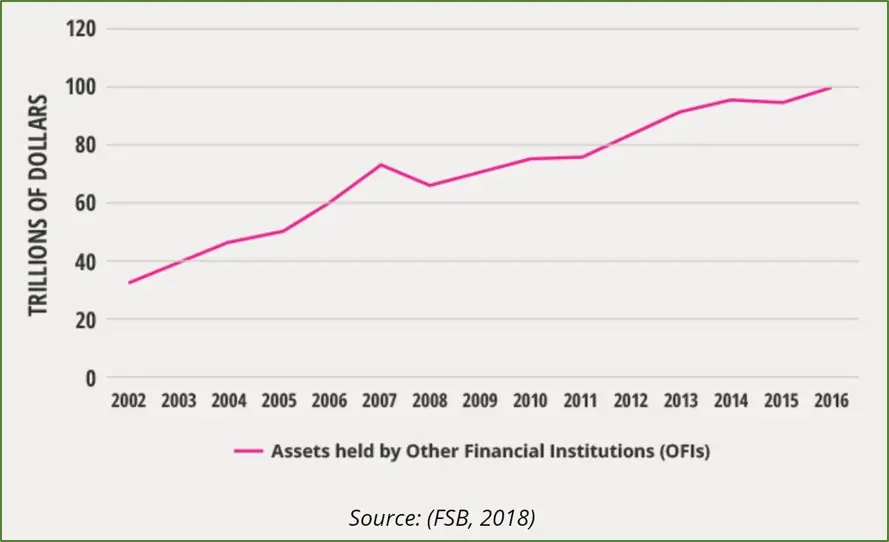
Shadow banking industry is worth over a $100 trillion dollars These are funds that take investors’ money and direct it into stocks, bonds, real estate, master limited partnerships, private equity, and others. They are grouped together by the Financial Stability Board (FSB).
Asset Management Funds have emerged as the biggest players in the world as they group together all these funds in one organisation. They are also present in many banks who have set up their own asset management divisions. In traditional lending, the volume of lending by a bank is linked to the volume of deposits the bank receives and what it can borrow on the markets. Shadow banking works on the same principle.
So, for example, an investment fund takes in money from investors, issuing shares in the fund in return. In order to earn a return on the investment for its investors the fund uses this money to buy securities (for example, a bond issued by a country or company). Just as the bank acts as the "middleman" between savers and borrowers to earn a specified interest rate, the investment fund acts as the channel linking investors and countries/companies to earn an investment return. By raising funds from investors and then lending this money to countries/companies, shadow banking entities act like banks.
The explosion in shadow banking contributes to even more lending in the economy with material base on which to ever fully repay debts should they all be called in, creating systemic rick in capitalism. The Repurchase and Stock Borrowing and Lending market create similar risks
Text adapted from the Transnational Institute